Our first study day involved 23 participants and was immensely successful. The only complaint I heard was that there just wasn’t enough time. There was a buzz of excited interaction between people affected by breast cancer, research nurses, scientists and clinicians. We are hugely grateful to Val Speirs and her team for hosting the day, to all the speakers for giving us their time. A brief account of the day follows with links to the presentations given. (See somephotos)
Val Speirs Reader in Cellular Pathology, LIMM/University of Leeds (presentation and publication) talked about the collection & use of tissue and its value to cell biology, in particular, the need for access to appropriate and annotated clinical material to make significant new progress in breast cancer research. This need was identified in the Breast Cancer Campaign Gap Analysis (attached) and has lead to the Breast Cancer Campaign Tissue Bank initiative. The mission statement for which is: To provide, in partnership with Campaign, highly specialised breast cancer related biomaterials to support cutting-edge translational research for the benefit of the patient
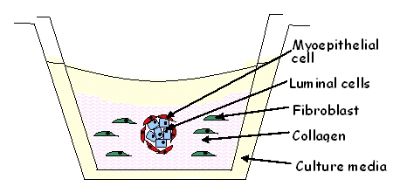 Debbie Holliday Research Fellow, LIMM/University of Leeds (presentation and publication) talked about the Development of laboratory models to study Breast Cancer. She has designed a 3 dimensional (3D) human model of breast cancer which includes the 3 major cell types involved in breast cancer: Tumour cells, Myoepithelial cells (protector cells) and Fibroblasts (tumour helper cells). These cells are grown in culture conditions which resemble those in the body ie grown in 3D rather than on a plastic Petri dish. Debbie Holliday Research Fellow, LIMM/University of Leeds (presentation and publication) talked about the Development of laboratory models to study Breast Cancer. She has designed a 3 dimensional (3D) human model of breast cancer which includes the 3 major cell types involved in breast cancer: Tumour cells, Myoepithelial cells (protector cells) and Fibroblasts (tumour helper cells). These cells are grown in culture conditions which resemble those in the body ie grown in 3D rather than on a plastic Petri dish.
Laura Smith Research Fellow, LIMM/University of Leeds (presentation) talked about using this 3D model to study radio-resistance in Breast Cancer. The main aim is to enable better patient selection for radiotherapy like the Oestrogen Receptor for Tamoxifen therapy and HER2 for Herceptin therapy. Nothing analogous is available to guide radiotherapy. The questions that can be asked using this 3D model are: Why do some cancers respond well to radiotherapy whilst others do not? What factors are involved? Testing radio-sensitizing drugs? Laura’s study is particularly focusing on the effects of radiotherapy on Fibroblasts.
Aidan Hindley GIFT Tissue Bank Nurse, University of Leeds/LTHT (presentation) talked about the whole body bank called GIFT based at the University of Leeds - Making a GIFT for the future
Rob Coleman Professor & Honorary Consultant Medical Oncologist, Academic Unit of Clinical Oncology, Weston Park Hospital, Sheffield (presentation) Talked about Breast Cancer and Bone Health: Normal Bone Health, Impact of Cancer Therapies on Bone Health, Therapeutic Strategies and Management Guidelines.
Dave Ardron, Chair NCRI Consumer Liaison Group, spoke to us about the NCRI and welcomed the formation of our group. He said he wished he had a similar group to call upon for clinical trials in lung cancer.
Lucy Ziegler Research Fellow, St James’s Institute of Oncology, University of Leeds (attached) consulted us on the measures of emotional distress she is developing with the COMPASS collaboration
Raj Achuthan Consultant Breast and Oncoplastic Surgeon, Leeds General Infirmary (presentation) talked about Different methods of breast reconstruction. He discussed the advantages and disadvantages of immediate versus delayed breast reconstruction and also the different types of reconstruction available.
Steven Pollock & Michele Cummings then took us on a tour of the laboratories connected with the tissue bank. We saw some of the cells they use in their 3D model and also the digital imaging setup which was all very impressive.
|